
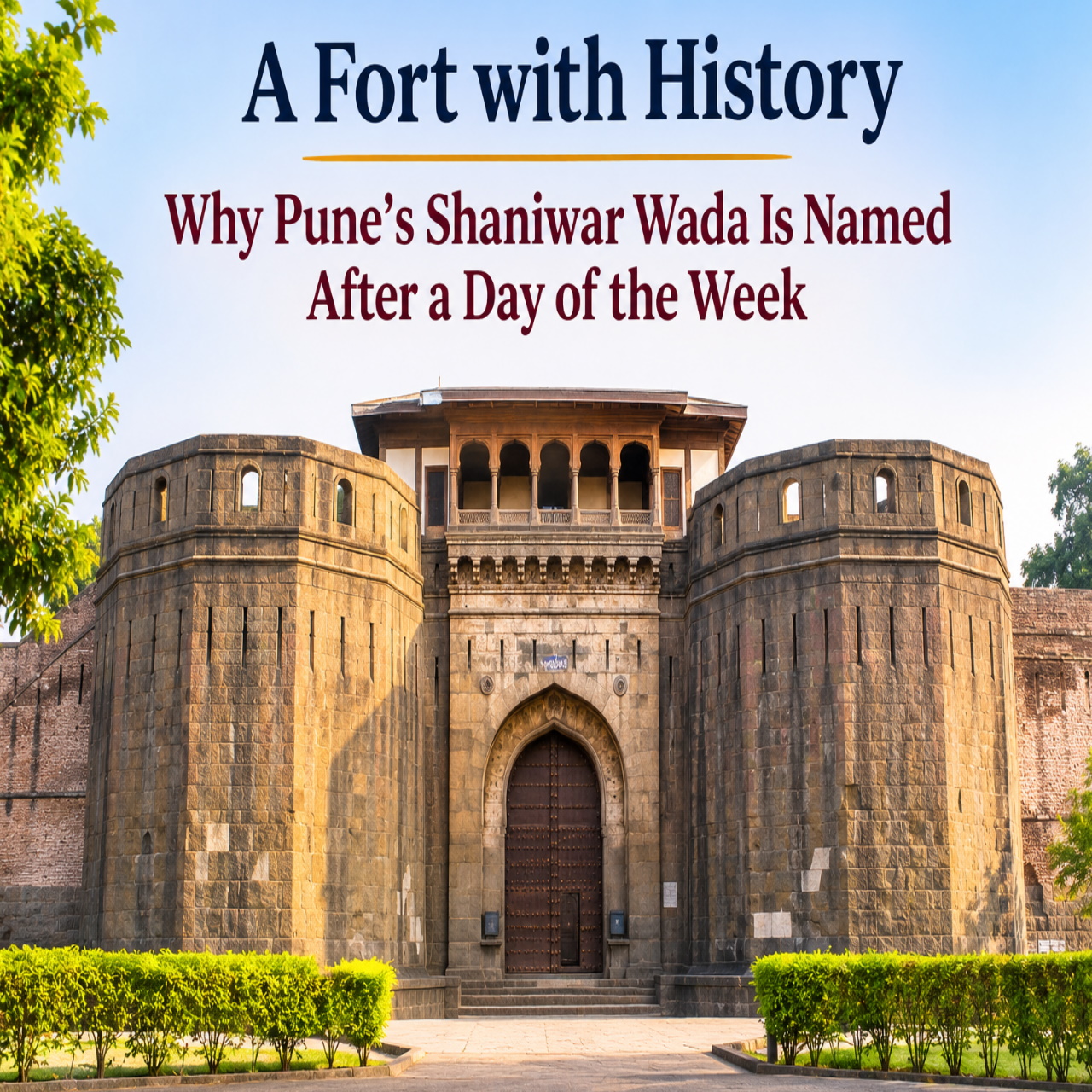
A Fort with History: Why Pune's Shaniwar Wada Is Named After a Day of the Week
In the heart of Pune, Maharashtra, stands Shaniwar Wada, a magnificent reminder of the Maratha Empire's political power, architectural craftsmanship, and royal heritage.
Although commonly called a fort, Shaniwar Wada was originally built as a fortified residential palace for the Peshwas, who served as prime ministers of the Maratha Empire.
But one question makes this historical monument particularly interesting: Why is such an important palace named after a day of the week?
The answer takes us back nearly 300 years to the reign of Peshwa Bajirao I.
Why Is Shaniwar Wada Named After Saturday?
The name Shaniwar Wada comes from two Marathi words:
- Shaniwar means Saturday.
- Wada means a traditional residence, mansion, or residential complex.
On Saturday, January 10, 1730, Peshwa Bajirao I laid the foundation stone of his new residence in Pune. Because construction began on a Saturday, the palace became known as Shaniwar Wada.
Interestingly, its inauguration is also traditionally dated to another Saturday, January 22, 1732.
The connection between the day of the week and the palace's foundation is documented in historical accounts and recognised by India's official tourism sources.
The History of Shaniwar Wada: From Royal Residence to Historical Landmark
Shaniwar Wada is one of Pune's most recognised historical monuments. Its story begins during the eighteenth century, when the Maratha Empire was expanding its political and military influence across India.
Peshwa Bajirao I, one of the most prominent military leaders in Maratha history, decided to establish an important residence and administrative centre in Pune.
The foundation stone was laid on January 10, 1730, and the original palace was completed in 1732. Over subsequent decades, later Peshwas expanded the complex with additional buildings, courtyards, defensive walls, and gateways.
Shaniwar Wada eventually became an important centre of Peshwa administration, where political discussions, military planning, official ceremonies, and royal family activities took place.
Its history reflects both the achievements and internal conflicts of the Peshwa period.
Who Built Shaniwar Wada?
Shaniwar Wada was founded by Peshwa Bajirao I, who served under Chhatrapati Shahu Maharaj.
Bajirao I became Peshwa in 1720 and is remembered for his military campaigns and his role in expanding Maratha influence.
As Pune became increasingly important to Peshwa administration, a substantial residence was needed to accommodate official responsibilities and family life.
The palace was designed to serve several purposes. It provided living quarters for the Peshwa household, space for administrative activities, and facilities for important visitors and official gatherings.
Its fortified design also reflected the security requirements of an influential political residence.
Why Was Saturday Considered Important?
Saturday is known as Shaniwar in Marathi and several other Indian languages.
In traditional Hindu calendars, particular days and auspicious timings may be selected for ceremonies, construction, and other important beginnings.
Historical accounts indicate that the foundation of Shaniwar Wada was laid on a Saturday regarded as suitable for the occasion.
The palace's opening ceremony also took place on a Saturday, reinforcing the association between the building and the day.
Although some popular explanations connect the name with Lord Shani, the established historical explanation is that it refers to the Saturday on which the foundation was laid.
This simple naming tradition has remained part of Pune's identity for almost three centuries.
Architecture of Shaniwar Wada
Shaniwar Wada was more than an ordinary residential building. It combined elements of Maratha architecture with design influences associated with other architectural traditions of the period.
The complex featured impressive entrances, stone fortifications, wooden residential structures, courtyards, decorated halls, gardens, and water features.
Many original buildings no longer survive, but the remaining fortifications provide an impression of the palace's former scale.
The Five Famous Gates
Shaniwar Wada is known for its five principal gateways.
1. Dilli Darwaza: The main entrance, facing north toward Delhi.
2. Mastani Darwaza: Traditionally associated with Mastani and also known as Ali Bahadur Darwaza.
3. Khidki Darwaza: A gateway whose name refers to a window.
4. Ganesh Darwaza: Associated with the Ganesh area of the palace complex.
5. Narayan Darwaza: Associated with the palace's later history.
Dilli Darwaza is particularly impressive because of its massive wooden doors and defensive construction.
The gates were designed to regulate entry and protect the residential complex.
Defensive Walls and Bastions
Shaniwar Wada's fortified enclosure included nine bastions.
These defensive structures helped protect the palace and demonstrated the importance of security in the Peshwa administrative centre.
The combination of strong exterior walls and elaborate interior residential buildings made Shaniwar Wada a distinctive example of a fortified palace.
Royal Halls and Courtyards
Historical descriptions refer to several impressive halls and rooms within the palace.
These included spaces for official meetings, religious activities, entertainment, and family gatherings.
The complex also featured decorated interiors and architectural details that reflected the wealth and status of the Peshwa household.
Although most of these structures have disappeared, their foundations and surviving remains help visitors understand the original layout.
The Famous Lotus Fountain
One of the most interesting architectural features associated with Shaniwar Wada is its lotus-shaped fountain, commonly known as Hazari Karanje.
Historical accounts describe an elaborate water feature with a lotus-inspired design and numerous water outlets.
The fountain demonstrates that the palace was not designed solely for security and administration. Gardens, water features, and decorative elements were also important parts of its residential environment.
The surviving fountain remains are among the features visitors can observe within the monument.
Shaniwar Wada and the Rise of Pune
Shaniwar Wada played a significant role in Pune's development as a political centre.
During the eighteenth century, Pune became increasingly associated with the administration of the Peshwas.
The palace served as a residence for successive members of the Peshwa family and as an important setting for government activities.
Officials, military commanders, visitors, and other influential figures were connected with the political life centred around the complex.
The growth of Peshwa administration contributed to Pune's wider development, leaving an architectural and cultural legacy that remains visible today.
Shaniwar Wada is therefore not simply an old building. It is an important landmark in the history of Pune and the Maratha Empire.
The Great Fire That Changed Shaniwar Wada
One of the most devastating events in the monument's history was the major fire of 1828.
The fire destroyed much of the original wooden palace complex.
Because extensive sections of the residential buildings were constructed using timber, the damage was severe.
Today, the remaining structures consist largely of the defensive walls, gateways, stone foundations, and other architectural remnants.
The destruction explains why visitors cannot see the complete palace as it existed during the height of Peshwa rule.
The surviving ruins nevertheless offer valuable evidence of the building's scale and original design.
Shaniwar Wada After the Decline of Peshwa Rule
The political position of the Peshwas changed dramatically after the Third Anglo-Maratha War.
In 1818, Peshwa Bajirao II was defeated, and the British East India Company established control over the Peshwa territories.
Shaniwar Wada consequently lost its former role as a centre of Peshwa government.
The subsequent fire further transformed the physical appearance of the palace.
Despite these changes, the site remained an important historical landmark.
Its surviving architecture continues to represent an influential chapter in Maharashtra's history.
What Can Visitors See at Shaniwar Wada Today?
Visitors to Shaniwar Wada can explore several surviving features of the historical complex.
The impressive Dilli Darwaza remains one of the monument's most recognisable structures.
The surrounding fortification walls and bastions provide a sense of the original defensive design.
Inside the complex, visitors can observe foundations, landscaped areas, and remains associated with former palace buildings and water features.
A statue of Bajirao I stands near the entrance, commemorating the Peshwa who founded the palace.
The site also provides opportunities to learn about Pune's history and the wider Maratha period.
Because opening hours, ticket prices, and visitor facilities may change, travellers should verify current information through official tourism or monument authorities before visiting.
Best Time to Visit Shaniwar Wada
Pune can be visited throughout the year, but the weather may influence how comfortable an outdoor heritage visit feels.
October to February generally offers relatively pleasant conditions for exploring historical sites.
During warmer months, early morning visits may be more comfortable than spending long periods outdoors in the afternoon.
The monsoon season can make the surroundings greener, although visitors should prepare for rain and slippery surfaces.
For photography, daylight provides a good opportunity to capture the gateways, fortification walls, and architectural details.
How to Reach Shaniwar Wada
Shaniwar Wada is situated in central Pune, Maharashtra.
It is accessible by road and public transport from different parts of the city.
Pune Junction railway station is a convenient arrival point for travellers coming by train.
Pune Airport serves domestic and international connections, subject to available flight schedules.
Visitors can use local transport services to reach the historical area.
Because Shaniwar Wada is located in a busy part of the city, allowing additional travel time during peak traffic periods is advisable.
Why Shaniwar Wada Remains Important
Shaniwar Wada represents several important aspects of Indian history.
It reflects the political influence of the Peshwas, the development of Pune, and the architectural traditions of eighteenth-century Maharashtra.
Its surviving gates and walls provide a physical connection to a period of significant change in the Maratha Empire.
The monument also demonstrates how historical places can retain their importance even after their original buildings have been damaged or destroyed.
For students, historians, travellers, and local residents, Shaniwar Wada remains an important place to explore the relationship between architecture, politics, and cultural memory.
Interesting Facts About Shaniwar Wada
1. Shaniwar Wada was founded by Peshwa Bajirao I.
2. Its foundation stone was laid on Saturday, January 10, 1730.
3. The original palace was completed in 1732.
4. Its name combines the Marathi words for Saturday and a traditional residential complex.
5. The monument was originally a fortified palace rather than a conventional military fort.
6. It has five principal gateways and nine bastions.
7. Dilli Darwaza is its most prominent entrance.
8. The palace was an important administrative centre of the Peshwas.
9. Its history includes the death of Peshwa Narayanrao in 1773.
10. A major fire in 1828 destroyed much of the original palace.
11. The lotus-shaped fountain is one of its notable architectural features.
12. The monument continues to be an important symbol of Pune's historical identity.
Conclusion
Shaniwar Wada is a remarkable historical monument whose name tells a story reaching back nearly three centuries.
Its foundation was laid on a Saturday in January 1730, giving rise to the name that continues to identify the palace today.
From the leadership of Bajirao I to the political activities of the Peshwas, from architectural splendour to tragic events and devastating fire, Shaniwar Wada has witnessed many important chapters in Maharashtra's history.
Although much of the original palace no longer survives, its gates, walls, and foundations continue to connect modern Pune with its historic past.
The next time someone asks why Pune's famous Shaniwar Wada is named after a day of the week, the answer is simple: it all began on a Saturday.



0 comments
Be the first to add a thoughtful comment.
Leave a comment
Your email will not be published. Comments are moderated.