
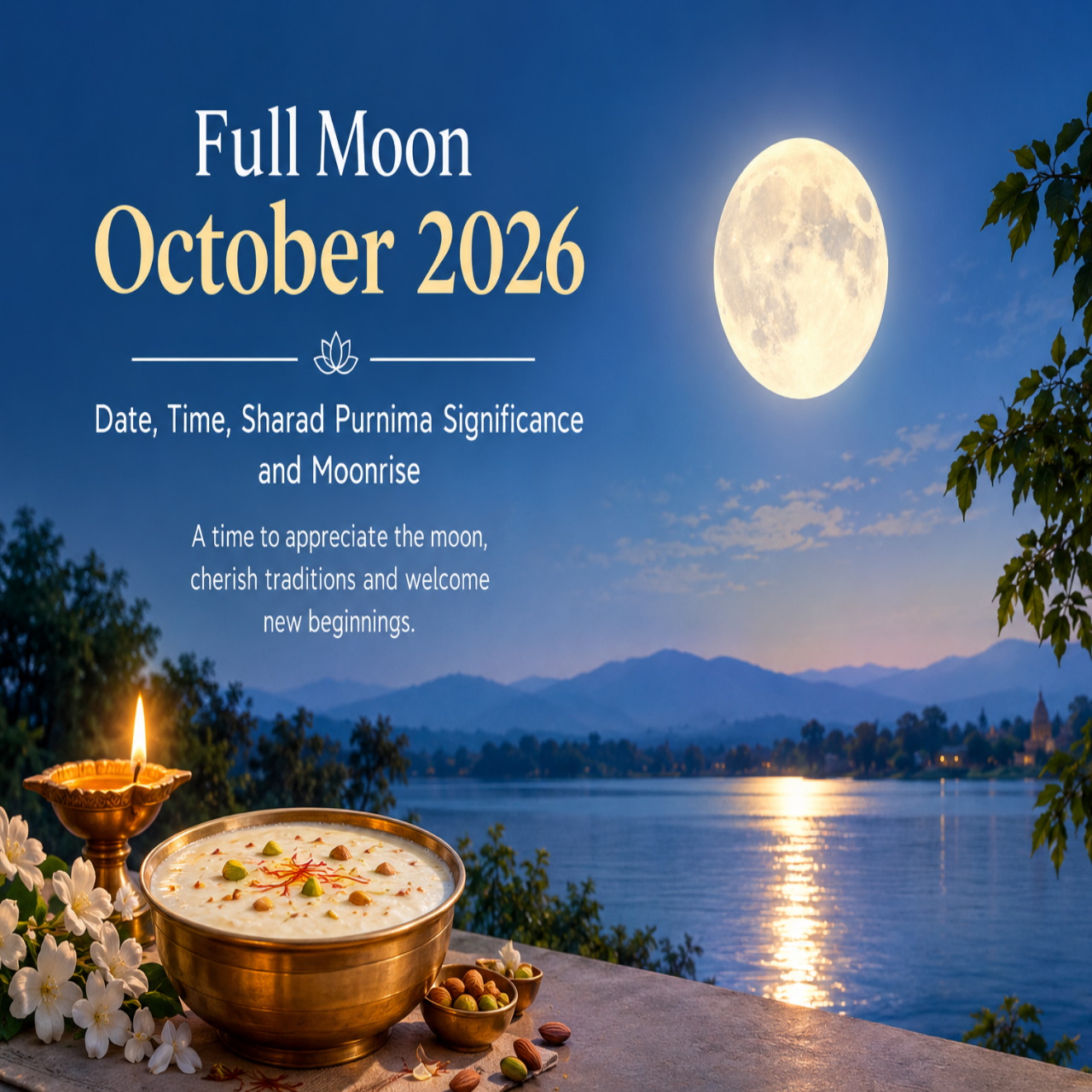
Full Moon October 2026: Date, Time, Sharad Purnima Significance and Moonrise
The Full Moon in October 2026 brings a beautiful opportunity to appreciate the night sky, learn about lunar cycles, and explore the cultural traditions associated with Sharad Purnima in India. The October Full Moon is often connected with autumn evenings, spiritual reflection, traditional prayers, and the beauty of the moon shining in a clear night sky.
Whether you enjoy astronomy, Indian festivals, nature, or cultural traditions, the October 2026 Full Moon offers something interesting to discover.
Full Moon October 2026: Date and Time
The astronomical Full Moon will occur on Monday, October 26, 2026. In India, this lunar event is associated with Ashwin Purnima, also known as Sharad Purnima in many Hindu traditions.
Full Moon details for October 2026:
Date: Monday, October 26, 2026
Exact Full Moon time: 9:41 AM IST
Traditional Purnima observance: Sunday evening, October 25, 2026, in many Indian calendars
Purnima Tithi: Approximately 11:55 AM on October 25 to 9:41 AM on October 26, Indian Standard Time
The astronomical Full Moon time and the traditional festival date are not always the same. Hindu observances may depend on the lunar day, local moonrise, and regional customs. For this reason, Sharad Purnima celebrations may take place on October 25, even though the exact astronomical Full Moon occurs on October 26.
Timings can vary slightly between Panchang sources and locations. Check a local Panchang for observance and moonrise details.
What Is a Full Moon?
A Full Moon occurs when the Moon appears fully illuminated from Earth. This happens when the Moon is positioned opposite the Sun in the sky, allowing its Earth-facing side to receive sunlight.
The Moon does not produce its own visible light. Instead, it reflects sunlight toward Earth.
A Full Moon usually appears as a bright, round disc in the night sky. Depending on the time of moonrise, the horizon, and atmospheric conditions, it may look golden or orange when low in the sky and appear whiter as it rises higher.
The Moon moves through a repeating cycle of phases, including the New Moon, crescent, First Quarter, gibbous, Full Moon, and waning phases. This cycle takes approximately 29.5 days.
The October Full Moon is part of this natural lunar rhythm.
Why Is the October Full Moon Special in India?
The October Full Moon is culturally important because it falls around Sharad Purnima, a traditional Hindu observance associated with the full moon of the Ashwin lunar month.
Sharad Purnima is connected with the arrival of the Sharad season, when the monsoon has generally begun to withdraw across much of India and the weather starts changing. In many places, the season brings cooler evenings and opportunities for outdoor gatherings.
The festival is associated with several traditions:
- Worship and prayer
- Spending time with family
- Observing the Full Moon
- Preparing traditional foods
- Listening to religious stories and devotional music
- Practising gratitude and reflection
Customs differ by region and family. Some people observe a fast, while others celebrate with prayers, food offerings, or a peaceful evening outdoors.
Sharad Purnima 2026: Meaning and Significance
Sharad Purnima is considered an auspicious night in several Hindu traditions. It represents devotion, abundance, seasonal change, and the symbolic brightness of the Full Moon.
The word Purnima refers to the full-moon lunar day. Sharad refers to the autumn season in the traditional Indian calendar.
For many devotees, Sharad Purnima is a time to express gratitude, pray for well-being, and reflect on the importance of balance and positivity in life.
The night is also associated with stories of Lord Krishna and the Raas Leela in some Vaishnava traditions. Devotional gatherings, singing, and storytelling may be organised in temples and communities.
In different parts of India, the festival may have distinct names and customs. The details of worship, fasting, and food preparation can vary according to regional and family traditions.
The Tradition of Watching the Full Moon
One of the simplest ways to appreciate the October Full Moon is to watch it rise.
Choose an open location with a clear view of the eastern horizon. A terrace, balcony, garden, park, or quiet outdoor space may be suitable, provided it is safe and accessible.
The Moon often looks especially striking when it is close to the horizon. Buildings, trees, and distant landscapes can create an attractive setting for viewing or photography.
For a more enjoyable experience:
- Check the local moonrise time before going outside.
- Choose a place with limited obstruction from buildings and trees.
- Allow your eyes a few minutes to adjust to the surroundings.
- Avoid looking directly at bright artificial lights while observing the sky.
- Take photographs without expecting the Moon to appear as large as it looks to the naked eye.
Remember that the exact moonrise time depends on your location. The Moon will not necessarily rise at the same time in every Indian city.
Why Does the Moon Look Bigger Near the Horizon?
Many people notice that the Moon appears unusually large when it rises or sets. This is commonly called the Moon illusion.
The Moon's apparent size does not dramatically increase simply because it is near the horizon. Instead, the surrounding landscape and the way the brain interprets distance can make it seem larger.
When the Moon appears beside buildings, trees, hills, or other familiar objects, the visual comparison can make it look much bigger than when it is high in the sky.
This effect makes moonrise an interesting time for observation and photography.
Moonlight, Sleep and Evening Relaxation
The Full Moon has inspired cultural beliefs, poetry, music, and reflection for centuries. Many people enjoy spending a quiet evening outdoors when the Moon is bright.
A peaceful evening routine may include walking, reading, meditation, prayer, or spending time with family. These activities can support relaxation when they fit comfortably into your usual schedule.
However, traditional beliefs about moonlight should be distinguished from established scientific evidence. There is no strong scientific evidence that sitting in Full Moon light provides special health benefits or that moonlight itself cures illnesses.
Sleep can be influenced by many factors, including light exposure, stress, daily routines, and individual sensitivity. If you find that bright outdoor light or late-night activities interfere with your sleep, maintain a comfortable evening environment and a regular bedtime.
Enjoy the Full Moon as a natural and cultural experience rather than as a substitute for medical care.
Traditional Food and Kheer on Sharad Purnima
Preparing kheer is one of the best-known traditions associated with Sharad Purnima in many Indian households.
Kheer is a traditional sweet dish generally prepared with milk, rice, and sugar, although recipes vary. Some families add cardamom, nuts, saffron, or other ingredients according to personal preference.
In certain traditions, kheer is placed outdoors under the moonlight as part of the celebration. Some devotees believe that the moonlight has special significance on this night.
This is a cultural and religious practice, not a scientifically established method of improving the nutritional value of food. If you prepare kheer outdoors, keep it covered and protected from insects, dust, animals, and other contamination. Refrigerate perishable food promptly rather than leaving it at room temperature for extended periods.
Families can also celebrate with their preferred traditional dishes, fruit, or a simple home-cooked meal.
Spiritual Practices for October Purnima
For people who observe Purnima as a spiritual occasion, the day can be an opportunity to slow down and focus on gratitude, kindness, and personal growth.
Depending on individual beliefs and customs, activities may include:
Prayer and meditation: Spend a few minutes in quiet reflection or devotional practice.
Charity: Offer food, clothing, or other appropriate support to people in need.
Gratitude: Reflect on the people, opportunities, and experiences that have made a positive difference in your life.
Family time: Share a meal, discuss traditions, or listen to stories from older family members.
Nature appreciation: Observe the Moon and notice how the night sky changes throughout the lunar cycle.
There is no single way that everyone must celebrate the Full Moon. The most meaningful approach is one that respects your beliefs, circumstances, and family traditions.
October Full Moon and Autumn Nature
October is a transition month in many parts of the Northern Hemisphere. The weather gradually changes, daylight hours shorten, and seasonal landscapes begin to look different.
In India, the experience varies widely by region. Some areas enjoy cooler evenings, while other places may remain warm or experience changing weather conditions.
The Full Moon provides an opportunity to observe the relationship between the Moon, the landscape, and the changing seasons.
You might notice the Moon reflecting on a lake, appearing above a line of trees, or illuminating a quiet street. Even a short observation can help you become more familiar with the night sky.
For photography, a clear sky and an unobstructed horizon are often more important than special equipment. A phone camera can capture a scenic moonrise, although a dedicated camera with a telephoto lens will generally reveal more lunar detail.
How to Photograph the October 2026 Full Moon
If you want to capture the Full Moon, a little planning can make your photographs more interesting.
First, check the moonrise time for your city. The exact time changes with location, so do not rely only on a national calendar.
Next, find a place where the horizon is visible. A landscape with trees, hills, a temple silhouette, or buildings may create a strong composition.
For smartphone photography:
- Keep the phone steady.
- Tap the Moon on the screen to focus.
- Reduce exposure if the Moon looks like a bright white circle.
- Avoid excessive digital zoom, which can reduce image quality.
- Try including a landscape feature rather than photographing only the Moon.
If using a dedicated camera, a tripod and manual exposure settings can help you capture more detail. The Moon is much brighter than the surrounding night sky, so a long exposure may make it appear overexposed.
Always choose a safe viewing and photography location, especially near roads, rooftops, or bodies of water.
Full Moon and the Importance of Astronomy
The Full Moon offers a simple introduction to astronomy. Observing lunar phases can help explain how the Moon moves around Earth and how its position relative to the Sun changes what we see.
The Moon's changing appearance is predictable. By observing it over several weeks, you can identify the transition from a thin crescent to a half-lit Moon, then to a Full Moon, followed by the waning phases.
A lunar calendar can help you plan observations throughout the year. October's Full Moon is one event in the broader cycle, followed by the November Full Moon on November 24, 2026, in India.
Although the Full Moon is visually striking, it is not always the best time to see faint stars or distant galaxies. The bright lunar surface increases the sky's background brightness. For many deep-sky observations, the darker sky around the New Moon is more suitable.
This contrast makes lunar observing and stargazing two different but complementary experiences.
Simple Ways to Celebrate Sharad Purnima
You do not need an elaborate celebration to appreciate Sharad Purnima. A few thoughtful activities can make the occasion meaningful.
Begin with a short prayer or moment of gratitude if that is part of your tradition. Prepare a favourite dish, read about the cultural history of the festival, or spend time with family.
You can also use the evening to learn something new about the Moon. Observe its position, compare its appearance with photographs, or introduce children to the lunar cycle.
If you are sharing the occasion on social media, consider posting a photograph of the Moon with a short message about gratitude, peace, nature, or cultural heritage.
Keep celebrations considerate of neighbours and the environment. Avoid littering outdoor spaces, and use lighting and decorations responsibly.
Conclusion
The October 2026 Full Moon brings together astronomy, seasonal beauty, and the cultural traditions of Sharad Purnima. The astronomical Full Moon occurs on October 26 at 9:41 AM IST, while many traditional Sharad Purnima observances take place on the evening of October 25.
Whether you celebrate through prayer, prepare a traditional dish, photograph the Moon, or simply enjoy a peaceful evening outdoors, the occasion offers a reminder to appreciate nature and make time for reflection.
Look up at the night sky, explore the lunar cycle, and enjoy the beauty of the October Full Moon.


0 comments
Be the first to add a thoughtful comment.
Leave a comment
Your email will not be published. Comments are moderated.