
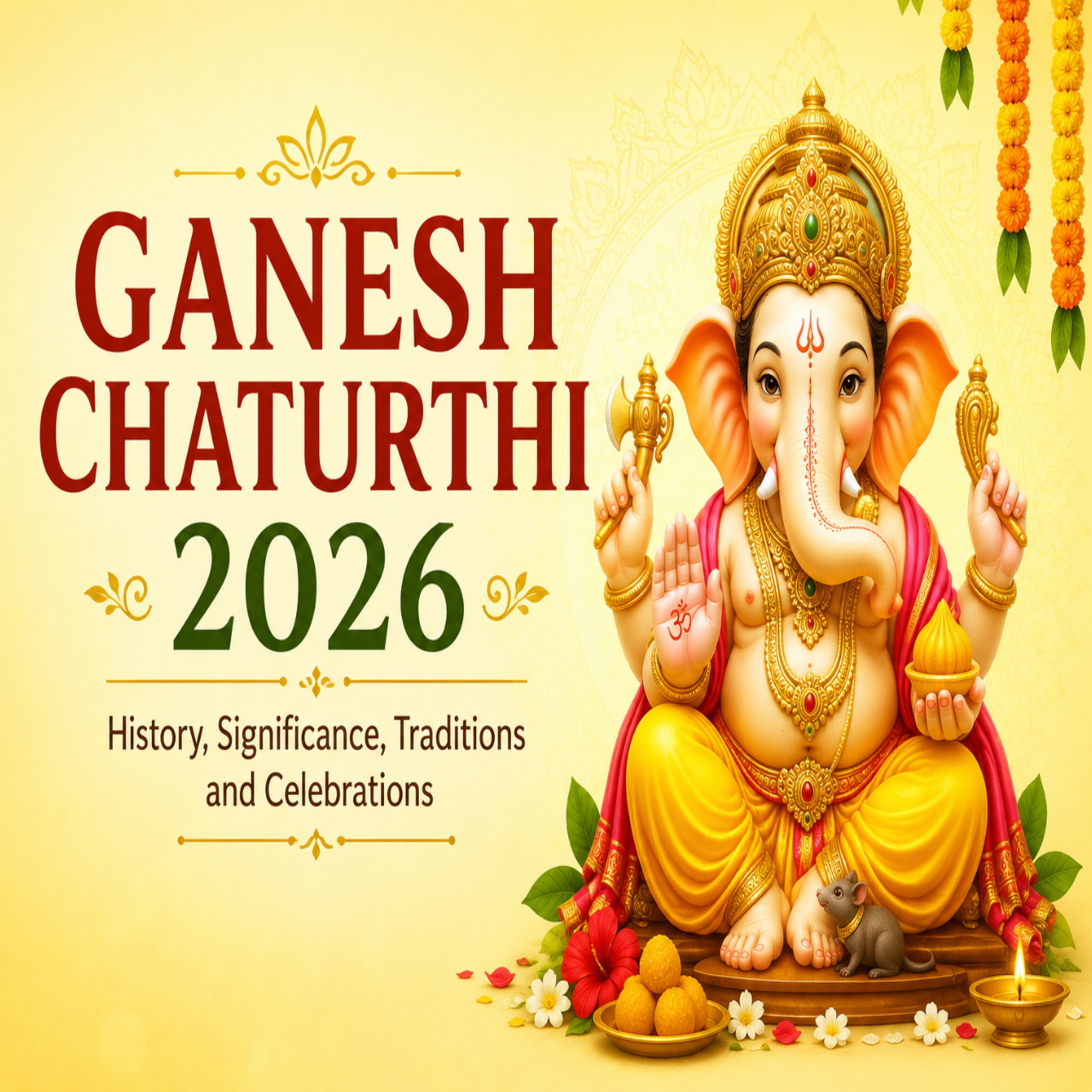
Ganesh Chaturthi 2026: History, Significance, Traditions and Celebrations
Ganesh Chaturthi is one of the most joyful and widely celebrated Hindu festivals in India. Dedicated to Lord Ganesha, the beloved elephant-headed deity associated with wisdom, knowledge, prosperity and the removal of obstacles, the festival brings families and communities together through prayers, cultural programs, decorations, music and traditional celebrations.
Ganesh Chaturthi is also known as Vinayaka Chaturthi or Ganeshotsav. Although the festival is celebrated across India, Maharashtra is particularly famous for its grand public Ganeshotsav celebrations in cities such as Mumbai and Pune.
In 2026, Ganesh Chaturthi will be celebrated on Monday, September 14. The main celebrations will begin with the installation and worship of Lord Ganesha, followed by several days of prayers and cultural activities. Anant Chaturdashi, when many devotees perform Ganesh Visarjan, will fall on Friday, September 25, 2026.
Ganesh Chaturthi 2026 Date and Important Information
Ganesh Chaturthi 2026 will be observed on Monday, September 14.
The Chaturthi tithi is reported to begin on September 14 and continue into September 15. The exact puja muhurat varies according to location because Hindu calendar calculations depend on the local sunrise and geographical location.
For Pune, the Madhyahna Ganesh Sthapana and Puja Muhurat is approximately 11:16 AM to 1:44 PM on September 14, 2026. For other Indian cities, the precise timing may be different.
Ganesh Visarjan and Anant Chaturdashi will take place on Friday, September 25, 2026, marking the traditional conclusion of the major 10-day Ganeshotsav period.
What Is Ganesh Chaturthi?
Ganesh Chaturthi is a Hindu festival celebrating Lord Ganesha. Devotees bring Ganesha idols into their homes, temples and community pandals and worship them with prayers, flowers, durva grass, sweets and other traditional offerings.
The festival can be celebrated for different durations depending on family and community traditions. Some households keep the idol for one and a half days, while others observe the festival for three, five, seven or ten days.
Large public celebrations traditionally continue until Anant Chaturdashi, when the idol is taken in procession and immersed during Visarjan.
Why Is Ganesh Chaturthi Celebrated?
Lord Ganesha holds an important place in Hindu traditions. He is commonly worshipped before beginning important activities, ceremonies and auspicious occasions.
Ganesha is associated with several qualities:
Wisdom and knowledge
Good fortune and prosperity
Removal of obstacles
New beginnings
Discipline and intelligence
Success in important activities
Ganesh Chaturthi provides devotees with an opportunity to express their faith while reflecting on these values in everyday life.
The Story of Lord Ganesha's Birth
One of the most widely known stories about Lord Ganesha describes his creation by Goddess Parvati.
According to the traditional story, Goddess Parvati created Ganesha and instructed him to guard the entrance while she was bathing. When Lord Shiva arrived, Ganesha stopped him because he was following his mother's instructions.
A conflict followed, and Ganesha was eventually beheaded. When Goddess Parvati learned what had happened, she became deeply distressed and demanded that Ganesha be restored.
Lord Shiva then arranged for Ganesha to receive the head of an elephant. Ganesha was brought back to life and became one of the most respected deities in Hindu tradition.
This story is interpreted in different ways, but it is commonly associated with devotion, obedience, transformation and the triumph of wisdom.
Symbolism of Lord Ganesha
The appearance of Lord Ganesha contains many symbolic elements.
Elephant Head
The elephant head is often associated with wisdom, intelligence, strength and the ability to overcome difficulties.
Large Ears
Large ears can symbolize the importance of listening carefully and learning from others.
Small Eyes
Small eyes are traditionally interpreted as representing concentration and focused attention.
Large Belly
The large belly is often associated with the ability to accept life's experiences and maintain balance.
Trunk
The trunk represents adaptability and strength. An elephant can use its trunk for both powerful and delicate tasks, making it a useful symbol of flexibility.
Mouse
The mouse is traditionally regarded as Lord Ganesha's vehicle. It can represent desire and the importance of controlling one's impulses.
Ganesh Chaturthi 2026 Puja and Sthapana
The installation of the Ganesha idol is one of the most important moments of Ganesh Chaturthi.
Before the installation, devotees generally clean and decorate the area where the idol will be placed. A clean platform may be prepared using cloth, flowers and decorative items.
The idol is then installed with prayers and traditional rituals. Families may perform Ganesh Puja, offer flowers and durva grass, light lamps and incense, and prepare traditional sweets as prasad.
Because puja traditions differ between families and regions, devotees can follow the practices taught by their family priest or their local tradition.
Ganesh Chaturthi Puja Samagri
Traditional Ganesh Puja may include items such as:
Ganesha idol
Flowers
Durva grass
Fruits
Modak
Other sweets
Coconut
Betel leaves
Betel nuts
Rice
Turmeric
Kumkum
Incense
Oil or ghee lamp
Clean cloth
Water
The exact list can vary depending on regional customs and family traditions.
The Importance of Modak
Modak is one of the most recognizable foods associated with Ganesh Chaturthi.
Modaks can be prepared in several varieties. Traditional steamed modaks may contain coconut and jaggery filling, while other versions can be made using different ingredients.
For many families, preparing modaks becomes an important part of the celebration. Parents and grandparents often involve children in preparing or decorating the sweets, creating an opportunity to pass traditional food practices from one generation to the next.
Ganeshotsav: The Ten-Day Celebration
Ganeshotsav is the extended celebration surrounding Ganesh Chaturthi.
During the festival, homes and public pandals may host daily prayers, aarti, cultural programs and community activities.
In Maharashtra, Ganeshotsav has become an important part of social and cultural life. Public celebrations can include large decorations, musical performances, traditional programs and community gatherings.
The atmosphere during Ganeshotsav is particularly vibrant in Mumbai, Pune and other parts of Maharashtra.
Ganesh Chaturthi Celebrations in Maharashtra
Maharashtra is internationally known for its large-scale Ganesh Chaturthi celebrations.
Mumbai and Pune become especially active during Ganeshotsav, with numerous household and public Ganesha idols.
Public pandals often attract large numbers of devotees. Famous celebrations have become part of the cultural identity of Maharashtra, combining religious devotion with community participation and artistic creativity.
Pune has a particularly strong historical connection with public Ganeshotsav and is known for traditional mandals, processions and cultural programs.
Ganesh Chaturthi in Mumbai
Mumbai's Ganeshotsav is one of the most prominent festival celebrations in India.
Large public idols, decorated pandals, processions, music and enthusiastic participation are characteristic of the festival.
Some of Mumbai's famous Ganesh celebrations attract devotees from different parts of India. The arrival of Ganesha idols and the final Visarjan processions are major cultural events.
The festival also provides opportunities for community organizations, volunteers and local businesses to participate in social and cultural activities.
Ganesh Chaturthi in Pune
Pune has a special place in the history of Maharashtra's public Ganeshotsav tradition.
The city is known for its traditional Ganesh mandals, cultural programs and processions.
During Ganesh Chaturthi, different parts of Pune become centers of celebration. Families visit Ganesh mandals, participate in aarti and enjoy cultural programs.
The city's celebrations combine devotion, history, culture and community participation.
Eco-Friendly Ganesh Chaturthi 2026
Environmental responsibility is becoming an increasingly important part of Ganesh Chaturthi celebrations.
Traditional immersion practices can create environmental challenges when idols are made from materials that do not easily dissolve or when synthetic paints and decorations enter water bodies.
In 2026, there is growing attention in Maharashtra toward clay idols and clay recycling as a more environmentally responsible approach to Ganeshotsav. Recent reporting has highlighted efforts to collect and recycle clay from idols after immersion.
Devotees can consider several environmentally responsible practices:
Choose natural clay idols
Prefer natural or environmentally safer colors
Avoid unnecessary plastic decorations
Use reusable decorations
Reduce single-use materials
Follow designated municipal immersion facilities
Consider home immersion where permitted and appropriate
Dispose of flowers and other festival materials responsibly
Eco-friendly celebrations demonstrate that religious traditions and environmental responsibility can work together.
Ganesh Visarjan 2026
Ganesh Visarjan is the traditional immersion of the Ganesha idol.
For many devotees, Visarjan represents a spiritual reminder that everything in the physical world is temporary. After welcoming Lord Ganesha into the home or community, devotees eventually bid farewell while carrying forward his blessings and teachings.
Anant Chaturdashi will be observed on Friday, September 25, 2026, and it traditionally marks the conclusion of the major 10-day Ganeshotsav celebration.
Visarjan processions can include devotional songs, drums, dancing, prayers and the traditional chant:
Ganpati Bappa Morya
Different cities and communities follow their own immersion schedules and arrangements.
Devotees should follow local authority instructions and use designated immersion locations to help maintain public safety and environmental cleanliness.
Ganesh Chaturthi Celebrations Across India
Although Maharashtra is particularly famous for Ganeshotsav, Ganesh Chaturthi is celebrated in many parts of India.
In Andhra Pradesh and Telangana, the festival is commonly known as Vinayaka Chavithi.
In Karnataka, Tamil Nadu and other southern states, families observe the festival with regional customs and traditional offerings.
In Goa, Gujarat, Madhya Pradesh, Chhattisgarh and other regions, Ganesh Chaturthi is also celebrated with local variations.
Indian communities outside India also organize Ganesh Chaturthi celebrations, demonstrating the festival's growing global cultural presence.
How Families Can Celebrate Ganesh Chaturthi at Home
Ganesh Chaturthi does not need to involve an elaborate celebration. A simple family celebration can be equally meaningful.
Families can:
Clean and decorate a small prayer area
Bring an appropriate Ganesha idol
Perform prayers according to family tradition
Prepare homemade prasad
Make modaks together
Read stories about Lord Ganesha
Teach children about the meaning of the festival
Sing traditional aarti
Use environmentally responsible decorations
Keep the celebration peaceful and respectful
Children and Ganesh Chaturthi
Ganesh Chaturthi can be an excellent opportunity for children to learn about Indian culture and traditions.
Parents can explain the symbolism associated with Lord Ganesha and involve children in simple activities such as decorating the prayer area, preparing flowers, making traditional sweets or creating eco-friendly decorations.
Children can also participate in educational activities related to recycling, clay idol making and environmental awareness.
This makes the festival more than a religious celebration. It becomes an opportunity for cultural learning and family bonding.
Spiritual Lessons From Lord Ganesha
Ganesh Chaturthi is not only about celebrations and decorations. It also encourages reflection on values that can be applied to everyday life.
Think Before Acting
Wisdom and careful thinking are important before making decisions.
Listen and Learn
The symbolism of Ganesha's large ears reminds us of the importance of listening.
Adapt to Change
The elephant's trunk can be viewed as a symbol of adaptability and flexibility.
Control Desires
The relationship between Ganesha and his mouse vehicle can be interpreted as a reminder to manage desires and impulses.
Respect Knowledge
Lord Ganesha is strongly associated with wisdom and learning.
Embrace New Beginnings
Ganesha is traditionally worshipped at the beginning of important activities, making him a symbol of positive beginnings.
Responsible Ganesh Chaturthi Celebration
Large celebrations can generate significant amounts of waste. Responsible planning can help reduce the environmental impact without reducing the joy of the festival.
People can choose reusable decorations, minimize plastic, use natural materials and follow local guidelines for idol immersion.
Community organizers can also provide waste collection facilities, water stations and clear instructions for visitors.
Recent initiatives in Maharashtra demonstrate increasing interest in sustainable Ganesh celebrations, including the recycling and reuse of clay from idols.
Ganesh Chaturthi as a Celebration of Unity
Ganeshotsav has a strong community dimension.
People from different backgrounds participate in public celebrations, visit pandals and join cultural activities.
The festival can encourage cooperation among residents, volunteers, artists, local organizations and community groups.
Recent reporting from Nagpur has also highlighted eco-friendly idol-making workshops involving students from diverse religious and social backgrounds, showing how festival activities can encourage environmental awareness and community harmony.
Ganesh Chaturthi and Modern Life
Modern celebrations are increasingly combining tradition with technology and sustainability.
Families may use digital invitations, online schedules and social media to share festival greetings. Community organizations can use digital platforms to communicate event information and coordinate volunteers.
At the same time, traditional values remain at the center of the celebration.
The ideal approach is not to replace tradition with technology but to use modern tools to make celebrations more organized, accessible and environmentally responsible.
Why Ganesh Chaturthi Remains Important
Ganesh Chaturthi continues to be important because it brings together spirituality, family, culture, art and community.
For some people, it is primarily a religious occasion. For others, it is also a cultural celebration and an opportunity to reconnect with family and community.
The festival's emphasis on wisdom, new beginnings and overcoming obstacles gives it relevance beyond the festival period.
Ganesh Chaturthi 2026 is therefore an opportunity to celebrate tradition while also embracing responsible and sustainable practices.
Conclusion
Ganesh Chaturthi is much more than the installation of a Ganesha idol or a grand public celebration. It is a festival centered around faith, wisdom, family, community and positive beginnings.
In 2026, Ganesh Chaturthi will be celebrated on Monday, September 14, with Anant Chaturdashi and the traditional conclusion of the major Ganeshotsav period on September 25.
As families and communities prepare to welcome Lord Ganesha, they can preserve traditional customs while making thoughtful choices for the environment.
A meaningful Ganesh Chaturthi can combine devotion with responsibility, celebration with cleanliness, and tradition with sustainability.
Ganpati Bappa Morya!
Ganeshotsav refers to the extended festival celebration associated with Ganesh Chaturthi!
Learn about Ganesh Chaturthi 2026, including date, puja timing, history, Lord Ganesha's significance, traditions, modak, Ganeshotsav, Visarjan and eco-friendly celebrations.
◉ 477 views◇ 0 comments

0 comments
Be the first to add a thoughtful comment.
Leave a comment
Your email will not be published. Comments are moderated.