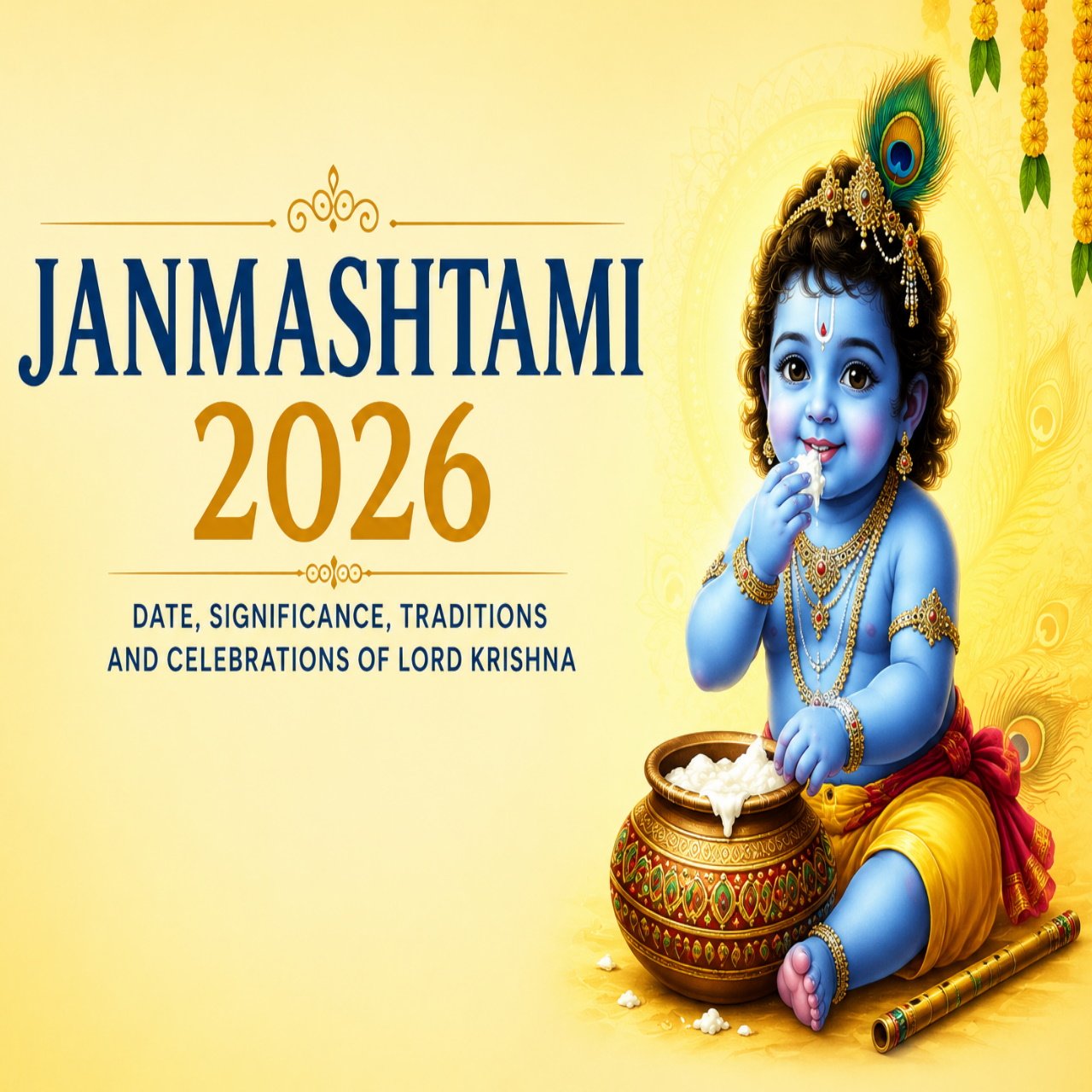
Janmashtami 2026: Date, Significance, Traditions and Celebrations of Lord Krishna
Learn about Janmashtami 2026, including the date, significance, Lord Krishna's birth story, fasting, midnight puja, Dahi Handi, traditions and celebrations across India.
PPrashantPublished August 28, 2026 · 7 min read
Janmashtami 2026: Date, Significance, Traditions a
Janmashtami 2026: Date, Significance, Traditions and Celebrations of Lord Krishna
Introduction
Janmashtami is one of the most important and widely celebrated Hindu festivals in India. Also known as Krishna Janmashtami, Gokulashtami, Krishna Jayanti and Shrikrishna Jayanti, the festival celebrates the birth of Lord Krishna, one of the most beloved and revered deities in Hindu tradition.
Janmashtami is celebrated with devotion, fasting, prayers, bhajans, kirtans, temple decorations and midnight celebrations. From homes and temples to large public celebrations, the festival brings families and communities together in an atmosphere of faith, joy and spirituality.
In 2026, Krishna Janmashtami will be celebrated on Friday, September 4. The festival is associated with Krishna Paksha Ashtami in the month of Bhadrapada, and the main celebration is traditionally centered around the Nishita or midnight period.
The exact puja and fasting timings depend on the location and the Panchang tradition being followed. For example, Drik Panchang lists the Nishita Puja period in Pune at approximately 12:10 AM to 12:57 AM on September 5, 2026.
For millions of devotees, Janmashtami is more than a religious festival. It is an opportunity to remember the teachings of Lord Krishna, strengthen family relationships, practice devotion and reflect on values such as truth, compassion, duty and righteousness.
What Is Janmashtami?
Janmashtami marks the birth of Lord Krishna. According to Hindu tradition, Krishna appeared on Earth during the Dvapara Yuga to restore righteousness and protect those who followed the path of dharma.
The festival is observed on the eighth day of the dark fortnight, known as Krishna Paksha Ashtami. The birth of Krishna is traditionally associated with midnight, which is why devotees often stay awake until late at night for prayers and the ceremonial celebration of Krishna's birth.
The festival is also known by several regional names. In different parts of India, devotees may call it Krishna Janmashtami, Gokulashtami, Krishna Jayanthi, Krishnashtami or Ashtami Rohini.
Why Is Janmashtami Celebrated?
Janmashtami is celebrated to commemorate the divine birth of Lord Krishna.
According to traditional accounts, Krishna was born in Mathura at a time when the kingdom was ruled by his maternal uncle, King Kansa. Kansa had become a cruel ruler and was warned that the eighth child of his sister Devaki would become the cause of his downfall.
Devaki and her husband Vasudeva were imprisoned by Kansa. Their children were killed because Kansa feared the prophecy.
When Krishna was born, Vasudeva carried the newborn child from Mathura to Gokul to protect him from Kansa. Krishna was raised by Nanda and Yashoda in Gokul, where many stories of his childhood became an important part of Hindu culture and devotional tradition.
The story represents the triumph of good over evil and the restoration of righteousness.
Janmashtami 2026 Date
Krishna Janmashtami will be celebrated on Friday, September 4, 2026. The date is based on the Hindu lunar calendar and the observance of Krishna Paksha Ashtami.
The timing of the midnight celebration varies according to location because sunrise, sunset and local Panchang calculations differ from one city to another.
Devotees planning a home puja should therefore check their local Panchang for the exact Nishita Puja and fasting-breaking times.
In Pune, for example, the listed Nishita Puja period is approximately 12:10 AM to 12:57 AM on September 5.
Why Is Krishna's Birth Celebrated at Midnight?
According to Hindu tradition, Lord Krishna was born at midnight. Therefore, devotees traditionally observe the main birth celebration during the Nishita period.
Temples and homes may remain awake late into the night while devotees sing devotional songs, chant Krishna's name, read scriptures and wait for the midnight moment.
At midnight, the birth of Krishna is symbolically celebrated with:
Abhishekam New clothes for the Krishna idol Decorating the cradle Offering flowers Lighting lamps Performing aarti Offering prasad Singing bhajans
Devotees often place a small idol of baby Krishna in a decorated cradle and gently swing it as part of the celebration.
The Spiritual Significance of Janmashtami
Janmashtami has deep spiritual significance beyond the celebration of Krishna's birth.
Lord Krishna's teachings emphasize the importance of performing one's duty, maintaining balance, developing devotion and following the path of righteousness.
The Bhagavad Gita, traditionally associated with Krishna's dialogue with Arjuna, contains teachings about duty, selfless action, devotion and spiritual knowledge.
One of the central ideas associated with Krishna's teachings is that people should perform their responsibilities sincerely without becoming excessively attached to the results.
This message remains relevant in modern life, where people often face stress, uncertainty and pressure.
Janmashtami therefore provides an opportunity to reflect on how ancient spiritual teachings can inspire a balanced and meaningful life.
The Story of Lord Krishna's Birth
The traditional story of Krishna's birth begins in Mathura.
Devaki, the sister of King Kansa, married Vasudeva. During their wedding, a divine warning informed Kansa that Devaki's eighth child would bring about his downfall.
Kansa imprisoned Devaki and Vasudeva.
As the years passed, Kansa became increasingly fearful. According to the traditional account, Krishna was born as the eighth child during the night.
Vasudeva then carried the newborn Krishna to Gokul.
The journey across the Yamuna is one of the most famous stories associated with Krishna's birth. Traditional depictions show Vasudeva carrying baby Krishna while the river becomes passable.
Krishna was eventually raised in Gokul by Nanda and Yashoda.
His childhood stories include his playful activities, his love of butter, his friendship with the residents of Gokul and his association with Radha and the Gopis in devotional traditions.
These stories have inspired Indian literature, music, dance, painting, theatre and cinema for centuries.
Janmashtami Fasting
Fasting is an important practice for many devotees during Janmashtami.
Different families and traditions follow different fasting practices. Some devotees observe a strict fast, while others consume fruits, milk and permitted foods.
Some devotees continue their fast until the midnight celebration, while others follow a local religious tradition for breaking the fast on the following day.
Because fasting practices can vary according to health, age, family tradition and religious practice, individuals should follow the guidance appropriate to them.
For children, older adults and people with medical or dietary considerations, a strict fast may not be appropriate.
Janmashtami Puja at Home
Many families celebrate Janmashtami at home by creating a small devotional space for Lord Krishna.
A simple home celebration may include:
Cleaning the prayer area Decorating the space with flowers Placing an idol or image of baby Krishna Preparing a small cradle Lighting a diya Offering fruits and sweets Singing Krishna bhajans Reading devotional stories Performing aarti at midnight
The goal is not the size of the decoration or the expense of the celebration. The central focus is devotion and remembrance of Krishna.
Decorating the Krishna Cradle
The cradle of baby Krishna is an important part of many Janmashtami celebrations. Families may decorate the cradle using flowers, colorful fabrics, traditional ornaments and small decorative items. Some families create miniature scenes representing Gokul or Krishna's childhood. Children can also participate by helping decorate the cradle, preparing flowers or making simple artwork. This makes Janmashtami a meaningful family activity and helps younger generations learn about Indian cultural traditions. Dahi Handi and Krishna's Childhood Dahi Handi is one of the most energetic public traditions associated with Krishna's childhood.
The tradition is inspired by stories of young Krishna and his friends stealing butter and curd from household pots.
During Dahi Handi celebrations, a pot containing curd or other items is traditionally suspended at a height. Groups of participants form human pyramids to reach and break the pot.
Dahi Handi is especially popular in Maharashtra, where large community celebrations attract participants and spectators.
In 2026, Dahi Handi is observed on Saturday, September 5, following the main Janmashtami date in many calendars.
The tradition represents teamwork, determination, celebration and community participation.
Janmashtami in Mathura and Vrindavan
Mathura and Vrindavan hold special significance during Janmashtami because of their close association with Krishna's life.
Mathura is traditionally regarded as the birthplace of Lord Krishna, while Gokul and Vrindavan are associated with his childhood and youth.
During Janmashtami, temples and streets in these regions become centers of devotional activity.
Visitors may experience:
Temple decorations
Bhajans
Kirtans
Religious processions
Krishna birth ceremonies
Special aarti
Decorated idols
Cultural performances
Large crowds of devotees
Recent preparations in Mathura have included major arrangements for the 2026 celebration, including plans for a large drone show around the festival.
Anyone planning a pilgrimage should arrange accommodation and transportation early because popular locations can become extremely crowded during Janmashtami.
Janmashtami Celebrations Across India
Janmashtami is celebrated differently across different regions of India.
In Maharashtra, Dahi Handi is a major attraction, with teams competing in human-pyramid events.
In Uttar Pradesh, Mathura, Vrindavan and Gokul are important centers of celebration.
In Gujarat, temples and communities organize devotional programs and cultural activities.
In Maharashtra and other regions, families decorate homes and temples and organize midnight puja.
In South India, the festival may be known as Krishna Jayanthi or Gokulashtami, with traditions involving devotional offerings and decorations.
Some Vaishnava traditions place special importance on the relationship between Ashtami Tithi and Rohini Nakshatra when determining the observance.
Traditional Food and Prasad
Food is an important part of Janmashtami celebrations.
Common offerings may include:
Makhan Mishri
Panjiri
Milk-based sweets
Fruits
Dry fruits
Kheer
Makhana preparations
Sabudana dishes
Traditional fasting foods
Many devotees prepare foods associated with Krishna's childhood, particularly milk and butter-based offerings.
The food offered during puja is treated as prasad and shared with family members and visitors.
Parents can also use the occasion to teach children about the meaning of prasad, gratitude and sharing.
Janmashtami and Children
Janmashtami is especially popular among children because Krishna is often represented as a playful and joyful child.
Schools and families may organize:
Krishna costume activities
Radha-Krishna performances
Bhajan programs
Storytelling
Drawing competitions
Decorative crafts
Cradle decoration
Traditional dance programs
These activities introduce children to Indian mythology and cultural traditions in an engaging way.
The emphasis should be on learning, creativity, respect and participation rather than competition or expensive decorations.
Lessons From Lord Krishna
The life and teachings of Lord Krishna provide many lessons that remain relevant today.
Krishna's story demonstrates the importance of standing against injustice.
The value of wisdom
The Bhagavad Gita emphasizes the importance of knowledge and thoughtful decision-making.
The importance of devotion
Krishna's traditions highlight devotion as a path toward spiritual growth.
Balance in life
Krishna is traditionally associated with wisdom, leadership, friendship, music, celebration and spirituality.
Together, these qualities offer a message about living a balanced and purposeful life.
How to Celebrate Janmashtami Responsibly
Modern celebrations can combine tradition with environmental and social responsibility.
Families can choose:
Reusable decorations
Natural flowers
Clay diyas
Energy-efficient lighting
Locally prepared food
Minimal plastic
Eco-friendly materials
Community-based celebrations
Avoiding unnecessary waste can help make festivals more sustainable.
During public events, organizers should also prioritize crowd management, cleanliness, traffic control and safety.
The Message of Janmashtami in Modern Life
Janmashtami remains relevant because its message goes beyond a single historical or religious event.
Modern life brings challenges such as stress, competition, uncertainty and social pressure.
Krishna's teachings encourage people to focus on their responsibilities, maintain inner balance and act with wisdom.
For families, Janmashtami can be an opportunity to pause from daily routines and spend meaningful time together.
For communities, it provides an opportunity to celebrate cultural heritage.
For devotees, it is a time of prayer and spiritual reflection.
For children, it is a joyful introduction to stories and traditions that have shaped Indian culture for generations.
Janmashtami 2026: How Families Can Celebrate
Families looking for a simple Janmashtami celebration can plan the day around a few meaningful activities.
Morning
Clean the home and prayer area.
Decorate the Krishna idol or image.
Prepare flowers and puja items.
Plan the evening meal and prasad.
Afternoon
Read or listen to stories about Krishna.
Involve children in decoration activities.
Prepare traditional sweets or permitted fasting foods.
Evening
Light diyas.
Sing bhajans.
Read devotional texts.
Spend time with family.
Midnight
Perform the Krishna birth celebration.
Offer prayers.
Perform aarti.
Offer prasad.
Place baby Krishna in the decorated cradle.
The celebration does not need to be elaborate. A peaceful and devotional atmosphere can make the occasion meaningful.
Conclusion
Janmashtami 2026 will be celebrated on Friday, September 4, marking the birth of Lord Krishna. The festival will bring together devotion, tradition, family celebrations, cultural activities and community events across India.
From midnight prayers and Krishna's cradle ceremony to Dahi Handi, temple celebrations and devotional singing, Janmashtami represents one of India's most vibrant cultural and spiritual traditions.
The festival also offers timeless lessons about duty, courage, wisdom, devotion and righteousness.
As families prepare to celebrate Janmashtami 2026, the most important part of the festival is not the scale of the decorations or celebrations. It is the spirit of devotion, togetherness, gratitude and reflection.
May Janmashtami 2026 bring peace, happiness, wisdom and positivity to families and communities across India.
Useful answers
Frequently asked questions
What foods are prepared for Janmashtami? +
Common offerings include makhan mishri, panjiri, milk-based sweets, fruits, kheer, and various fasting foods. Traditions differ between families and regions.
What is Dahi Handi? +
Dahi Handi is a popular tradition associated with Krishna's playful childhood. Participants form human pyramids to reach and break a suspended pot, symbolizing teamwork and community celebration.
Reader conversation
0 comments
Be the first to add a thoughtful comment.
Join the discussion
Leave a comment
Your email will not be published. Comments are moderated.
Essential storage keeps the site working. With your permission, analytics helps us improve stories. Google manages advertising privacy choices separately where required. You can change your analytics choice at any time.


0 comments
Be the first to add a thoughtful comment.
Leave a comment
Your email will not be published. Comments are moderated.