
IT Outsourcing Models: How to Choose the Right One
Choosing the right IT outsourcing model can have a major impact on a company's technology costs, development speed, product quality, and long-term growth. Businesses today can choose from several outsourcing approaches, including project-based outsourcing, dedicated development teams, staff augmentation, managed services, and IT consulting.
The challenge is not finding an outsourcing company. The real challenge is choosing an outsourcing model that matches your business goals, technical requirements, budget, timeline, and level of control.
A startup building its first SaaS product may need a dedicated development team, while an established company that needs help maintaining its existing applications may benefit more from staff augmentation or managed IT services.
This guide explains the major IT outsourcing models, their advantages and limitations, and the factors businesses should consider before selecting one.
What Is IT Outsourcing?
IT outsourcing is the practice of hiring an external technology company or specialized professionals to perform software development, infrastructure management, technical support, cybersecurity, testing, maintenance, or other IT-related activities.
Instead of handling every technology function internally, businesses work with an external provider that supplies the required expertise and resources.
IT outsourcing can range from hiring one specialist for a specific role to outsourcing an entire software development project or ongoing IT operation.
Common outsourced services include:
Software development
Web and mobile application development
Cloud and DevOps services
Software testing and quality assurance
IT support and maintenance
Cybersecurity
Data management
API development and integration
UI and UX development
Database management
Business automation
Technical consulting
Why Do Businesses Outsource IT?
Companies outsource IT for several reasons. Cost reduction is important, but it is not the only consideration.
Access to specialized expertise is one of the biggest advantages. Businesses can work with professionals who have experience with specific technologies without having to build a large internal team.
Outsourcing can also help companies:
Reduce recruitment and infrastructure costs
Accelerate software development
Access specialized technical skills
Scale development teams more easily
Improve operational efficiency
Support existing internal teams
Reduce time to market
Maintain legacy applications
Handle temporary increases in workload
Focus internal employees on strategic business activities
The right outsourcing model allows a company to obtain these benefits without losing necessary control over its technology.
Major IT Outsourcing Models
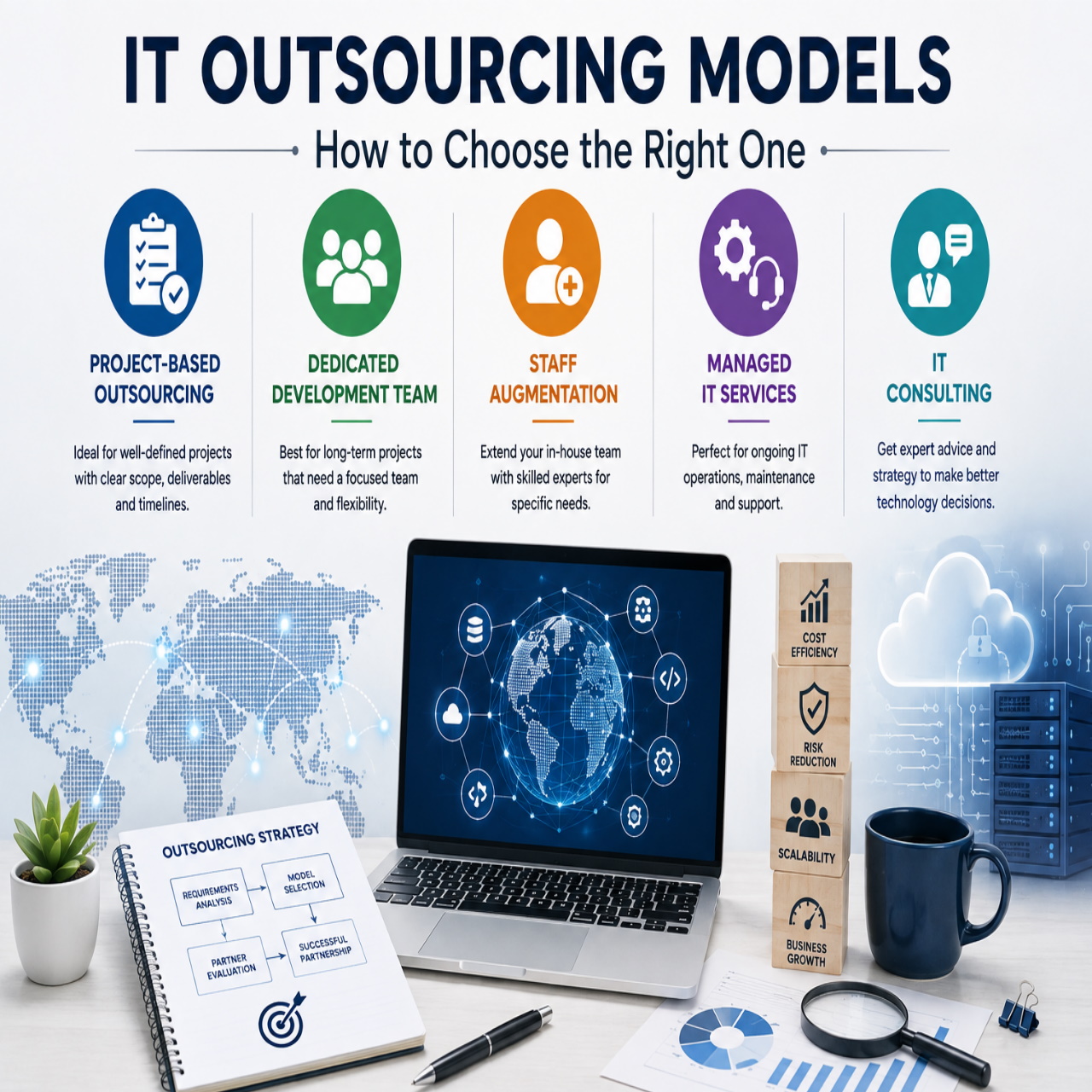
There is no single outsourcing model that works for every organization. The most common models are project-based outsourcing, dedicated development teams, staff augmentation, managed services, and IT consulting.
1. Project-Based IT Outsourcing
Project-based outsourcing is suitable when a company has a clearly defined project with specific requirements, deliverables, deadlines, and objectives.
The outsourcing provider typically manages the development process and delivers the agreed solution according to the project scope.
Examples include:
Developing a business website
Building a mobile application
Creating a CRM system
Developing an eCommerce platform
Integrating third-party APIs
Migrating an existing application
Building a reporting dashboard
Advantages
The project scope and expected deliverables are defined in advance.
Budget planning can be easier when requirements are stable.
The external provider manages much of the development process.
The business does not need to hire a permanent development team.
Limitations
Project-based outsourcing may become difficult when requirements change frequently.
Additional functionality may require changes to the scope, timeline, and budget.
This model is generally most effective when requirements are well documented before development begins.
Best for:
Businesses with clearly defined projects, fixed requirements, and specific delivery objectives.
2. Dedicated Development Team
A dedicated development team is an outsourced team that works exclusively on a client's project or product.
The team can include:
Software developers
Project managers
Business analysts
UI and UX designers
QA engineers
DevOps engineers
Technical architects
The client generally has more involvement in priorities, product decisions, and development direction than with a traditional fixed-scope project.
Advantages
Easy to scale the team as requirements change.
Greater flexibility during product development.
Long-term knowledge of the product can be retained within the team.
Suitable for SaaS products and continuously evolving platforms.
The client can have greater visibility into development activities.
Limitations
The client usually needs to participate more actively in product management.
The model may require longer-term commitment.
It may not be necessary for a small one-time project.
Best for:
Startups, SaaS companies, growing businesses, and organizations developing products over an extended period.
3. Staff Augmentation
Staff augmentation involves adding external specialists to an existing internal development team.
For example, a company may have experienced .NET developers but need additional developers with DevOps, mobile development, or testing expertise.
Instead of hiring permanent employees, the company adds external specialists for a specific period.
Advantages
Quick access to specialized skills.
The internal team retains project control.
Flexible team expansion.
Useful for temporary workloads.
Can help fill technical skill gaps.
Limitations
The client remains responsible for managing the augmented resources.
Communication and coordination need to be handled effectively.
The external developers may require time to understand the company's systems and processes.
Best for:
Businesses that already have an internal technology team but need additional resources or specialized expertise.
4. Managed IT Services
Managed services involve outsourcing ongoing IT operations to an external provider.
The provider may continuously manage areas such as:
Infrastructure
Cloud environments
Servers
Networks
Cybersecurity
Application monitoring
Technical support
Backups
DevOps
System maintenance
Managed services are generally focused on ongoing operational performance rather than delivering a single software project.
Advantages
Predictable ongoing support.
Reduced pressure on internal IT teams.
Continuous monitoring and maintenance.
Access to specialized operational expertise.
Improved response to technical incidents.
Limitations
Businesses need to clearly define service levels and responsibilities.
Less direct control over certain operational activities may be required.
The provider must have strong security and operational processes.
Best for:
Companies that need continuous technical support, infrastructure management, monitoring, or maintenance.
5. IT Consulting
IT consulting is different from development outsourcing. A consulting partner primarily provides expertise, recommendations, planning, architecture, or strategic guidance.
An IT consultant may help a company:
Choose a technology stack
Design application architecture
Plan cloud migration
Review existing software
Create a digital transformation roadmap
Improve development processes
Evaluate cybersecurity risks
Plan technology budgets
Define technical requirements
IT consulting can also be combined with software development or managed services.
Best for:
Businesses that understand the business problem but need experienced technical guidance before deciding how to implement a solution.
IT Outsourcing Models Compared
Project-based outsourcing is generally best for a clearly defined project.
Dedicated development teams are better for long-term and evolving products.
Staff augmentation works well when an internal team needs additional specialists.
Managed services are suitable for ongoing IT operations and support.
IT consulting is appropriate when strategic or technical guidance is the primary requirement.
The right choice depends on the organization's specific situation rather than simply selecting the model with the lowest price.
How to Choose the Right IT Outsourcing Model
Before selecting an outsourcing model, evaluate several important factors.
1. Define Your Business Goal
Start by asking what you want the outsourcing partner to accomplish.
Are you developing a new product?
Do you need additional developers?
Are you trying to reduce infrastructure management responsibilities?
Do you need technical architecture advice?
Are you maintaining an existing application?
The answer will narrow down the appropriate outsourcing models.
2. Evaluate Project Complexity
A simple website and a large enterprise application have very different outsourcing requirements.
Consider:
Number of integrations
Technology stack
Security requirements
User volume
Performance requirements
Regulatory requirements
Development timeline
Maintenance needs
Complex projects usually benefit from flexible and collaborative outsourcing models.
3. Consider Your Internal Team
Your existing technical team should influence the outsourcing decision.
If you have a strong internal engineering department but lack specific expertise, staff augmentation may be appropriate.
If you have limited internal technical resources, a dedicated team or complete project outsourcing may be more suitable.
4. Determine the Required Level of Control
Consider how closely your organization needs to manage development.
If your internal team wants direct control over technical resources, staff augmentation may be a good choice.
If you prefer the outsourcing partner to manage project execution, project-based outsourcing may be more appropriate.
5. Consider Your Budget
Cost should be evaluated alongside quality, flexibility, risk, and long-term value.
The cheapest provider is not necessarily the most cost-effective option.
A low-cost development team that produces unreliable software may create additional expenses through bug fixing, security issues, delays, and maintenance.
Instead, evaluate total cost of ownership.
Consider development costs, maintenance, infrastructure, support, management time, and potential rework.
6. Evaluate Scalability
Business requirements can change quickly.
Ask whether the outsourcing model allows you to:
Add developers
Reduce resources
Introduce new technical skills
Increase support capacity
Expand into new platforms
Support additional users
A flexible model can be especially valuable for growing businesses.
7. Consider Communication Requirements
Communication is one of the most important factors in outsourcing success.
Before selecting a provider, understand:
Communication channels
Working hours
Time-zone differences
Meeting schedules
Reporting processes
Project management tools
Escalation procedures
A technically strong provider can still be difficult to work with if communication is poor.
8. Review Security and Data Protection
Security should be evaluated before sharing source code, customer information, credentials, or business data.
Ask potential providers about:
Access controls
Data protection
Secure development practices
Source-code security
Backup procedures
Employee access policies
Confidentiality agreements
Security testing
Incident response
Businesses handling sensitive information should give security requirements particularly high priority.
9. Review Technical Expertise
Do not evaluate an outsourcing provider only by the number of developers it employs.
Review its experience with the technologies and business requirements relevant to your project.
For example, a company developing a Microsoft-based business application may need experience with:
.NET
ASP.NET
C#
VB.NET
Entity Framework
SQL Server
Web API
Cloud services
Reporting systems
Third-party API integrations
Relevant technical experience can reduce development risks and improve delivery quality.
10. Check References and Previous Work
Ask for examples of similar projects.
Look for evidence of:
Relevant technical experience
Successful long-term engagements
Quality development practices
Reliable communication
Strong client relationships
Industry knowledge
Case studies can provide useful information, but businesses should also verify claims where possible.
Common Mistakes When Choosing an IT Outsourcing Model
Choosing Based Only on Price
A low hourly rate may appear attractive, but it does not necessarily result in lower project costs.
Ignoring Communication
Poor communication can cause delays, misunderstandings, and rework.
Not Defining Responsibilities
Both parties should clearly understand who manages requirements, testing, deployment, security, infrastructure, and support.
Failing to Plan for Maintenance
Software requires ongoing updates, monitoring, security patches, and bug fixes after launch.
Not Considering Scalability
A model that works for a five-person project may not work when the product grows significantly.
Choosing the Wrong Contract Structure
The commercial agreement should match the project requirements. Fixed-scope work, flexible product development, and ongoing support may require different engagement structures.
How to Build a Successful IT Outsourcing Partnership
Successful outsourcing depends on more than selecting the right model.
Businesses should establish clear communication, measurable objectives, documentation, security processes, and regular reviews.
A strong outsourcing partnership typically includes:
Clearly defined requirements
Agreed project objectives
Transparent pricing
Defined responsibilities
Regular progress reporting
Quality assurance processes
Security controls
Source-code ownership terms
Documentation
Support and maintenance arrangements
Performance reviews
The relationship should also evolve as the business changes. A company may begin with staff augmentation and later move toward a dedicated development team or managed services arrangement.
Conclusion
Choosing the right IT outsourcing model is a strategic business decision, not simply a way to reduce development costs.
Project-based outsourcing can work well for clearly defined requirements. Dedicated development teams offer flexibility for long-term product development. Staff augmentation can strengthen an existing internal team, while managed services can provide ongoing technical operations and support. IT consulting is useful when organizations need experienced guidance before making major technology decisions.
The best model depends on your business objectives, project complexity, internal capabilities, budget, security requirements, timeline, and desired level of control.
Before signing an outsourcing agreement, clearly define your goals, evaluate potential providers, review technical expertise, establish communication processes, and understand how the relationship can scale over time.
When the outsourcing model and provider are aligned with the organization's actual needs, outsourcing can become more than a cost-saving strategy. It can provide access to specialized expertise, accelerate innovation, improve operational efficiency, and help businesses build technology that supports long-term growth.
IT Outsourcing Models: How to Choose the Right One
Explore project-based outsourcing, dedicated teams, staff augmentation, managed services and IT consulting to choose the right IT outsourcing model for your business.
◉ 308 views◇ 0 comments



0 comments
Be the first to add a thoughtful comment.
Leave a comment
Your email will not be published. Comments are moderated.